Showing posts with label Books. Show all posts

Sunday, April 8, 2018

Book Review: Lincoln in the Bardo by George Saunders

This is a weird book.

I just have to say that to start. I had a hard time getting into it at the beginning. Because it was weird. But once you get past that, this novel is amazing.

The story is about Abraham Lincoln visiting his son's grave the night after the funeral, told from the perspective a few of the spirits haunting the cemetery. Saunders drew the narrative from a historical tidbit about Lincoln actually visiting the grave several times.

It's written like this--half of it is historical quotations from books (more on that in a moment) that set the scene, the other half dialogue attributed to dozens of characters that come and go with really no rhyme or reason.

I know it sounds insane and hard to follow. And it is. But after about forty pages you find the rhythm of the story, and it all just makes sense.

So those historical notes from other books. Some of them are real. Most of them are fiction, written by George Saunders himself. But they're so well done that you can't tell the difference. Maybe the most entertaining is a section where several different "historical" accounts describe the moon on the night of Willie Lincoln's death. Almost every account describes the moon differently, which is something you'd expect from real historical accounts. But Saunders made them up.

And then the other half of the book. It's told by these spirits. You get a paragraph or more of their voice, and then an attribution below it so you know who is talking. That's it. Like I said earlier, it's a little weird when you begin reading. It's hard to figure out what's going on, and who's talking. But eventually you settle into the structure, and it actually becomes a fast read.

So then there's Saunders' writing. I'll only use one example, but man, there are a few lines in this novel that will take your breath away, that will make you weep. Such as:

"His mind was freshly inclined toward sorrow; toward the fact that the world was full of sorrow; that everyone labored under some burden of sorrow; that all were suffering; that whatever way one took in this world, one must try to remember that all were suffering (none content; all wronged, neglected, overlooked, misunderstood), and therefore one must do what one could to lighten the load of those with whom one came into contact; that his current state of sorrow was not uniquely his, not at all, but, rather, its like had been felt, would yet be felt, by scores of others, in all times, in every time, and must not be prolonged or exaggerated, because, in this state, he could be of no help to anyone and, given, that his position in the world situated him to be either of great help or great harm, it would not do to stay low, if he could help it."

And:

"I was in error when I saw him as fixed and stable and thought I would have him forever. He was never fixed, nor stable, but always just a passing temporary energy-burst. I had reason to know this. Had he not looked this way at birth, that way at four, another way at seven, been made entirely anew at nine? He had never stayed the same, even instant to instant.

He came out of nothingness, took form, was loved, was always bound to return to nothingness.

Only I did not think it would be so soon.

Or that he would precede us.

...I am not stable and Mary not stable and the very buildings and monuments here are not stable and the greater city not stable and the wide world not stable. All alter, are altering, in every instant."

This book is riddled with passages like those above. It's really beautiful.

Take the time to read this novel, because it's worth it. It'll be a struggle at first, but it's worth it in the end.

Tuesday, January 30, 2018

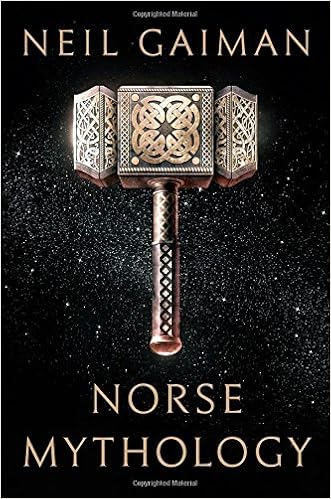
Book Review: Norse Mythology


I've always like mythology. I prefer the Greek tales to the Norse ones, but the Literary Disco podcast discussed this book on a recent episode, and I like to read what they do so I can follow along. I don't know why I prefer the Greek myths to the Norse. Maybe they're a little more Western in nature, with more linear plots and characters I understand better. Norse mythology has always seemed random and confusing to me.

With that being said, Neil Gaiman has done a great job with this collection of Norse myths. He writes in a unique style--it's contemporary, yet classic. Somehow it works. The myths are placed in almost chronological order (well, as best you can place myths in order), helping you understand the context of each tale a little better.

I haven't read anything else by Gaiman, but he seems to have a playful, witty voice which pairs well with these stories. The Norse myths don't take themselves too seriously, and Gaiman went with that, keeping the writing light while staying true to the original texts. This book is a must-read for fans of Gaiman or mythology.

Sunday, January 28, 2018

Book Review: Washington's Spies by Alexander Rose

Centered around a group of friends who become spies for George Washington during the Revolutionary War, Washington's Spies gives an in-depth history of espionage in the early days of the United States. Alexander Rose does a tremendous job of painting a portrait of America at the time of the Revolution, building the world in which the spies he writes about inhabit. The result is a book which educates you on not only military and espionage history, but the culture of the colonies which rebelled against Great Britain and why they did.

Rose expounds upon each spy's background and personality, which in the hands of a lesser writer would come across as tedious and exhausting. But Rose is able to pull interesting tidbits and quirks from each person, giving the reader a full understanding of their personality. Granted, he had a lot of material to work with, because these spies wrote quite a few letters, but it's still an impressive feat.

If you have any interest in history, this book will appeal to you.

Thursday, January 4, 2018

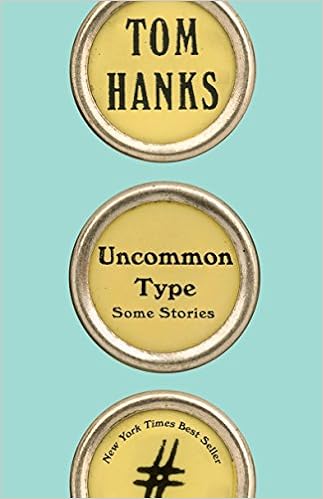
Book Review: Uncommon Type by Tom Hanks


Look, I'm a fan of Tom Hanks. So this review is biased. When I found out about this book of short stories, I knew I was going to buy it. I asked for it for Christmas. I didn't even read a description or a review. I just wanted it. I knew it might be a risk, because sometimes celebrities are bad writers. But I was committed.

First, I'll get to my rating--this book was really, really good. And that made me realize why I'm such a fan of Tom Hanks.

He's an amazing actor, receiving Oscars for his roles in Philadelphia and Forest Gump while also getting robbed for his roles in Saving Private Ryan and Apollo 13. And Castaway. And Road to Perdition. Basically I believe that Tom Hanks should have about eight Oscars, okay? And then there's classics like You've Got Mail and That Thing You Do.

Which brings me to the That Thing You Do soundtrack. It's also amazing, and Hanks produced it through his label Playtone, which is also his production company that produced hits like My Big Fat Greek Wedding, The Polar Express and the television series Band of Brothers.

This is my point--Tom Hanks produces nothing but quality. I'm sure he's had some misses, but overall, everything he does is first-class. This book, and these stories, are no different.

As for the title, every story in this collection involves a typewriter. Sometimes it is a minor part of the story, and other times it serves as the plot itself. Most of the stories revolve around average, working-class people experiencing a life-changing event or going through an interesting part of their life. A man has an exhausting three week romantic relationship with a friend. A recently divorced woman moves into a new neighborhood. A child goes for his first plane ride. Only two stories take place in exotic or fantastic places--an actor experiences sudden fame after being cast in the latest action blockbuster, and (one of my favorite chapters in the book) a billionaire goes back in time and falls in love.

The entire collection is steeped with Hanks' playful tone and occasional gravitas when the situation turns serious. Hanks seems genuinely interested in every character, never using them as tools to move the plot forward or as simple caricatures. It's almost as if he's just recording events he witnessed or experienced himself.

The best books make you wish they never ended. Uncommon Type does that, and I hope Hanks returns to the world of literature sometime soon.