Showing posts with label Travel. Show all posts

Saturday, September 22, 2018

Caddo Mounds


Around 1200 years ago, a group of Caddo known as the Hasinai tribe established a settlement in the Piney Woods of East Texas. Over time, it grew to be a large village, with ceremonial mounds for worship and burials. The village was a center for trade, located on a well-traveled Native American route through Texas. The Caddo were part of the mound building cultures of North America.

A thousand years later, all that remains is a few small hills. Now there are tiny East Texas towns surrounding the site, most smaller than the Caddo village itself.

I've always thought that was weird. Growing up in East Texas, the places I considered big cities--Dallas, Houston, Austin--were far away and permanent. They'd always been the places with the most people. When you're young, you don't realize that things change. The way things are is the way they've always been, and they'll always stay the same. At least that's what we like to think.

But a thousand years ago, this site that now sits in the middle of nowhere was the big city. Young Caddo teenagers probably dreamed of leaving their small village and moving to the site near present day Alto, Texas. It was the place everything was happening. Traders from villages as far away as Oklahoma, Arkansas, and Louisiana came there to exchange their goods. Elaborate burial and religious ceremonies were held there. All the important warriors, priests, and political leaders lived at this site. It must have bustled with activity, something young people love.

There was a lot going on here.


Pictured above is the Low Platform Mound. Archaeological evidence shows there were no buildings on this mound, and no one is quite sure what is was used for. It's possible it was a place for community functions. I like to think it was a town square used for meetings and dances.


The mound in the picture above is the High Temple Mound. It was originally much larger than what we see today. According to the information at the Caddo Mounds State Historic Site, the mound used to be three times its current length and up to 35 feet high. Buildings for worship and government sat on top of the mound. Imagine living in the forests of East Texas and then coming to this city with its towering mounds. These were the skyscrapers of the first millennium.

From time to time, the buildings on top of the mound were ceremonially destroyed by fire. The ashes of these buildings would be covered with dirt, and new ones would then be constructed. Fire was an essential part of Caddo ceremonial life and their creation myth. It's possible there was a building with a perpetual flame, always burning, always signaling new life.


The largest mound (at least in height) at present is the Burial Mound. It was about 20 feet at its highest and over 90 feet in diameter. It contained around 90 bodies in about 30 burial pits. Burial in this mound was reserved for important community leaders.

The site was abandoned by the Hasinai in the 13th century, long before any Europeans set foot in Texas. The site had lost cultural and political influence by this time because the villages surrounding it had grown larger. Still, the site held some significance.

Alonso de Leon, Spanish governor of Coahuila,started a route that would eventually turn into the El Camino Real de los Tejas. The route was turned into an actual road by Domingo Teran de los Rios, the first governor of Spanish Texas. This "royal highway" went from Mexico City to Natchitoches, Louisiana.

The Caddo Mounds site was a rest stop on this route. The site was was frequently referred to as Paraje el Cerrito, which means Place of the Little Hill. This was due to the Camino Real going right by the Burial Mound at the site. Here's a photo of me on the Camino Real. You can see the Burial Mound in the background.


Did the Spanish travelers on this road know they were stopping to rest at what was once a large city? Maybe. Though the site had been abandoned for more than three hundred years, there surely had to be artifacts lying on the ground. The remaining Caddo tribe members must have known the history of the area and told stories of the city to these new European visitors.

Still, this site, and what was once here, became an afterthought. The site was excavated over the years, but was only really thoroughly researched in the 20th century.

It's always a sobering thought--things change, and the things we think are permanent are actually temporary. This city was the center of Caddo culture in Texas for five hundred years. And then it wasn't. It faded from significance to the Caddo, and then was forgotten to the world. I'll bet those who lived there thought that could never happen. But it did.

History simultaneously reminds me that I'm not as important as I think I am, and that what I do matters more than I think. It's a paradox I love to think about, and traveling to Caddo Mounds helped me do that.

Friday, July 13, 2018

I Went to a Major League Soccer Game


So the first thing you have to know is I don't like soccer. Well, it's not that I dislike it. More like, I don't care. In my opinion, nothing much happens. And the game can end in a tie. I'm sorry, in soccer it's called a draw. But anyway, you can sit and watch a game for three hours and it ends in a tie. Nobody wins. Including everyone watching.

But I got free tickets to FC Dallas' match against the Vancouver White Caps. So I went, because I have an open mind and like sports. My wife came along, because she was interested.

Things got off to a rocky start almost immediately. The game was at 3 p.m. on a Saturday afternoon. The temperature was a cool 95 degrees and our seats were in direct sun. There's also a no-bag policy, of which we were unaware. I had brought my camera in a bag, and my wife's purse wasn't allowed, either. So after walking more than half a mile from the (free!) parking, we had to walk all the way back to our car, ditch our bags, then walk all the way back to the stadium. Needless to say, we were a little cranky by the time we got in the stadium.

We immediately found a concession stand and bought water and Gatorade to quench what was now an immense thirst. We stood in a corner of the a concourse, in the shade, because there were no benches or other sitting areas. Going to our seats in the middle of the blazing sun didn't seem appealing at the time.

Eventually, though, we got tired of standing, and found our seats. The game was already underway. I watched as the ball was kicked around. I don't understand anything about soccer strategy, so I quickly got bored. There was a pretty ruckus group of fans behind the goal that was nearest to us. They constantly sang and shouted throughout the half. There was even a band that played nonstop. It was awesome, and gave the crowd a party atmosphere.

FC Dallas scored a goal at some point near the end of the first half, but I'll admit, I pretty much missed it. I was looking around the stadium, taking in the sights, because I'd gotten a little bored with the game. I looked up in time to see the ball rolling into the goal. The crowd started celebrating, singing loudly and waving silk scarves with the team's logo on them. It was fun.

My wife and I left during the half. If you really love soccer, I'm sorry. But we were both really feeling the heat, and the thought of spending another hour in the heat, watching a game I don't understand just felt unbearable.

I'd like to go to another soccer game, but with someone who really knows and enjoys the sport. Maybe they could help me see the appeal. We had a pretty good time, but I don't think soccer is for me.

Tuesday, August 1, 2017

The Mermaid of Salado


Once upon a time, there was a beautiful Native American woman named Sirena. She loved a brave in her tribe very much, but he didn't return her affections. One day, as she sat by the riverside, crying and wishing her love would be requited, a magical catfish swam nearby and heard her. It offered her a deal--it would make the brave love her, but only if she promised to return to the river on every full moon and swim with it. There was one condition, however: if another human ever saw her, she would become a mermaid permanently, forever.

Sirena agreed to the magical catfish's deal, and she soon married the handsome brave. They lived happily together for a while, and she held up her end of the bargain with the catfish. Everything was wonderful until one fateful night. Sirena's husband came to the river, and there, by the bright moonlight, saw his wife swimming. She instantly became a mermaid, forever, and her tears feed the cold spring that feeds the river to this day.

The town of Salado sits near that spring, and they've built a statue to commemorate the legend.


I've visited the statue of that mermaid twice. Once when I was twelve, and while wading in the chilly waters of the spring, I slipped on a rock and fell. I wasn't hurt, but I did get soaked. I found it again on a trip to Salado, when I took the photo above. The statue had been moved down river by flooding, and I couldn't find the spring. The water was still cold and crisp, though.

I've always thought this was a sad story. Sirena only wanted to be with the one she loved, and the deal she made with the catfish wasn't terribly bad. The only reason things went wrong was pure circumstance and chance.

We've all had that happen, where things don't work out because the universe is random. You're late to an interview for your dream job because of a flat tire and you don't get hired. That love letter you wrote is never delivered. You meet your soulmate the day before you move to a city five hundred miles away.

Sirena makes me think of true love and how sometimes it ends badly. Her story makes me appreciate what I have, and that's why I like to visit her when I'm in the area.

Tuesday, July 25, 2017

Greatest Generation Aircraft


My father used to take me to the airport when I was a little kid. We would watch jets and airplanes take off and land for a few hours. Airplanes have always been something we both loved, a connection we always had together. So when I found out about Greatest Generation Aircraft, I knew I'd found the perfect Father's Day gift.

Greatest Generation Aircraft gives you the chance to fly in a genuine World War II airplane, a Douglas C-47 Skytrain. The C-47 is a DC-3 modified for military use. It was primarily used to transport troops during WWII. The DC-3 was one of the most popular airplanes in the 1930's, and is credited with popularizing air travel in the early 20th century.


Greatest Generation Aircraft flies out of a tiny airport near Fort Worth, Texas, but it's a little intimidating when you get there. Unless you're accustomed to flying in private jets. GGA takes up shop in a small airline's terminal, and you have to wait for the whole party to arrive. The group
    that runs GGA are friendly, accommodating, and knowledgeable about aircraft.

   My dad and I had a couple of questions. How did they get parts for repairs? How old were the
   pilots? We pictured a couple of 90 year old men with bad eyesight flying us over Fort Worth
   while we hoped no one had a heart attack. The good people at GGA assured us that all the pilots
   were capable and that the plane was in good shape, considering it was over fifty years old.

   There's no AC in the C-47, so GGA only flies in the spring and early summer. They also do
   Christmas flights in December. The seats are all on one side, instead of lined on the side like they
   would be in an actual military plane. GGA had to make some modifications to satisfy the FAA.
   As you can see from the picture below, it's like riding in a giant metal tube.

The guy behind me isn't my dad.

It's also loud. Really loud. You have to yell, just to hear the person sitting next to you. You also feel every single bump, pitch, and move the plane makes. It's a little unnerving at first, but you get used to it after a few minutes. I tried to take this picture with the cockpit behind me when we hit a little turbulence:


It came out a little blurry.

In the end, all the turbulence and heat are worth it, because you get great views of downtown Fort Wroth and the surrounding area. It's a one of a kind experience, a chance to experience history and see the world from a few thousand feet.


Saturday, July 22, 2017

Thanks-giving Square


Nestled in the heart of downtown Dallas is a tiny park called Thanks-giving Square. It's an interesting little area with fountains, steps, and paths that meander throughout an acre or two. Somehow, despite being in a busy urban area, the park is quiet. If you happen to stumble upon it while exploring Dallas, it's a nice surprise.

Thanks-giving Square was the idea of four Dallas businessmen who wanted the burgeoning city to be known for more than wealth and ten gallon hats. The park was dedicated in 1976 and recognized by President Gerald Ford as a "major nation shrine." Despite President Ford's endorsement, I'd never heard of the park before the day I accidentally walked into it.

There are inspirational quotes and Bible verses in the walls and paths throughout the park. The fountains and flowing water create a peaceful atmosphere. It's easy to lose track of time just sitting on a bench.

A chapel sits in one corner of the square:


It's a place to sit and pray, or meditate. The ceiling is beautiful.


I like this place a lot. It's a good chance to rest while you're exploring Dallas, a place to think about all the good things in your life, all that you have to be grateful for. It invites you to slow down and think about everything you've been given, and why it matters.

Sunday, June 11, 2017

Salado College


While visiting Salado, Texas, with my family, we stopped at a glass blowers' shop and watched them make a vase. It was summer, and the glass blowers' shop held a fierce heat, so I took a walk. Across the road and up a small hill, I found the ruins of the building above. After wandering around a little while, I found a placard explaining I was seeing what remained of Salado College.


The college was founded in 1860 by group of prominent men in Bell County, Texas. It was the first college in the state of Texas to be operated without state or church funds. Further differing from other educational institutes of the time, it was co-educational. The first term enrolled seventy-five students, and attendance peaked at 307 students just a few years later.

There was a sharp decrease in enrollment due to the Panic of 1873, and in 1885 closed for good. It was operated as a private high school from 1890 until 1918. It became a free public high school until 1924, when it burned down. The fire was a little suspicious, but nothing came of those suspicions.


The town of Salado couldn't afford to rebuild the school, and the ruins remained for almost one hundred years. A foundation was established in 2011 to make sure the remains of the buildings were safe and it was opened to the public.


The area is wooded, quiet except for the numerous birds calling to one another and the occasional passing car. The site is raised up a small hill from the surrounding area, further isolating you from the rest of the world. When you're walking around the ruins of Salado College by yourself, it feels like you've made some sort of archaeological discovery and it's yours alone.

I'm glad I found it, and while I wouldn't say it's worth a trip out of your way on its own, if you're in Salado, it's cool to check out.

Saturday, June 10, 2017

Statue of Sam Houston

Off of Interstate Highway 45, near Huntsville, Texas, looms a statue of Sam Houston. Houston is a legend in the state of Texas, and the concrete likeness stands guard over every vehicle passing by. It's impossible to miss.


It's 67 feet tall and stands on a 10 foot base. The official name of the sculpture is "A Tribute to Courage" but most just call it Sam Houston or "Big Sam." It gives off the vibe that is often attributed to Sam Houston in history books. You feel a little safer standing beneath that hawk-like gaze.


Other than the statue, though, there's not much to see here. You can travel a little bit down the road and visit Huntsville State Park, which is great, but the statue park is quite small. There's a tiny museum and a gift shop. To reach the base of the statue, you have to walk a short trail, where you can find the decapitated head of Sam Houston:


It's kind of weird, just sitting there, looking like your judgmental uncle who got stoned for the first time. But it does give you a chance to take funny photos.

The Sam Houston Statue gives Texas a chance to project some pride, and it gives motorists on passing I-45 a chance to stop and stretch their legs. There's no cost to walk the trail or stand beneath the statue. If you're bored and just need to get out of the car and see a little bit of history, it's a great rest stop.

Sunday, June 4, 2017

Young's Cemetery

I think cemeteries are interesting. There's always little tidbits of history that you can pick up by looking around, especially in the very old ones. There is an especially unique cemetery in Plano, Texas, because it's old and it's got an odd location.


Young's cemetery was established in 1847 by Sam Young, a settler who moved to Collin County Texas from Illinois in 1842. The first burial was his wife, Patience Young, whose gravestone is the second oldest in Plano.

The cemetery is surrounded on two sides by an apartment complex, seen in the photo to the left, and on two sides by a public golf course, seen in the photo below. The only way to access the cemetery is through the apartment complex grounds. It lies at the rear of the property, next to a dog park and playground for the tenants.

The cemetery is often littered with stray golf balls. I picked up eleven on one trip. As you can tell in the photo to the left, golfers drive up on carts very close to the perimeter of the cemetery. You can hear them laughing and joking as they play, and I can only imagine that it's a weird experience for them as well.

Young died in 1891, and stipulated that anyone who wished to be buried in the cemetery could be laid to rest there. The last person to take up that offer was John Young, interred in 1928.


The grave of Sam Young and his second wife, Charity Ann Young.


The grave of Thomas Finley, a veteran of the War of 1812. You won't find many gravestones designating veterans of a war so early in American history in this part of Texas. I tried to find out a little more about Finley, but came up empty.


The cemetery is a registered Historical Landmark in Texas. Despite all the activity around it, it's a very peaceful place. There is a scatter garden filled with purple flowers and I think it's still being used. The entire cemetery is covered by large trees, so it's shaded and feels as cozy as a graveyard can be. Someone is taking care of it, though the grass is a little tall.

If you're in Plano and like old cemeteries, Young's Cemetery is an interesting stop.

Stay at the Cell Block


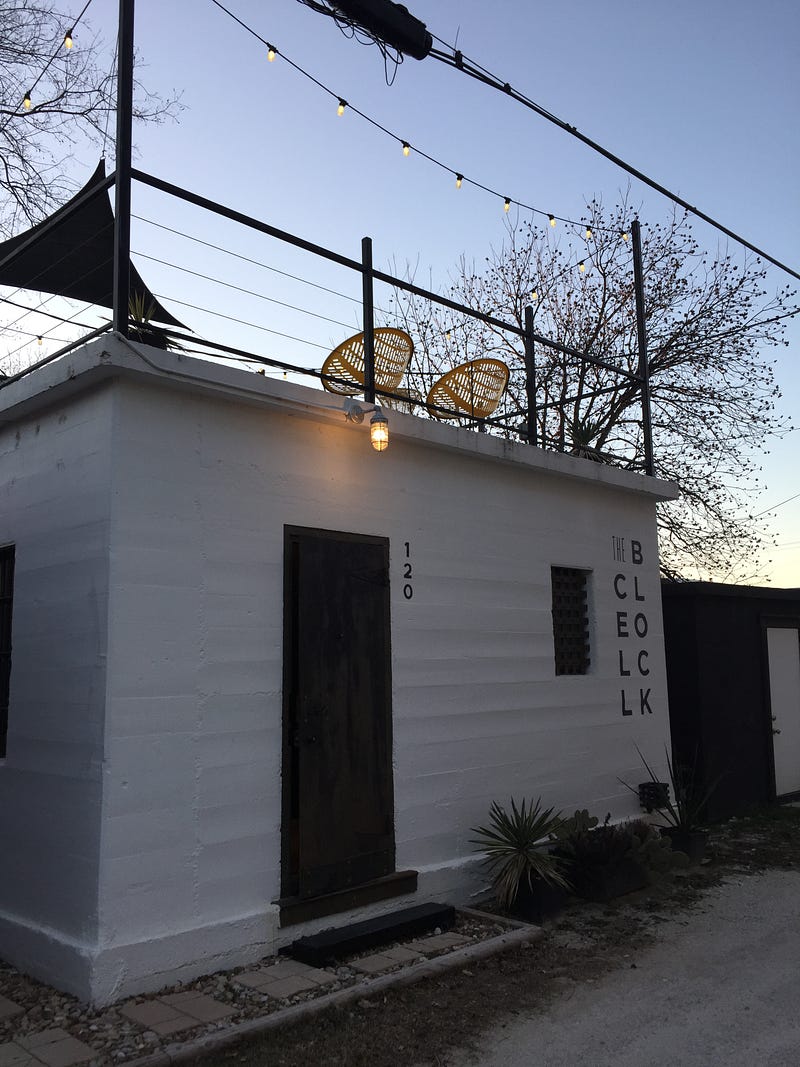
Spending the night in an old fashioned jail cell doesn’t sound like the most comfortable accommodations. But it is interesting. The Cell Block is a hotel room built into a jail last used in 1934. It’s in Clifton, Texas, a tiny town just a little northwest of Waco.
As soon as I read about it in Texas Monthly, I knew I had to stay there.
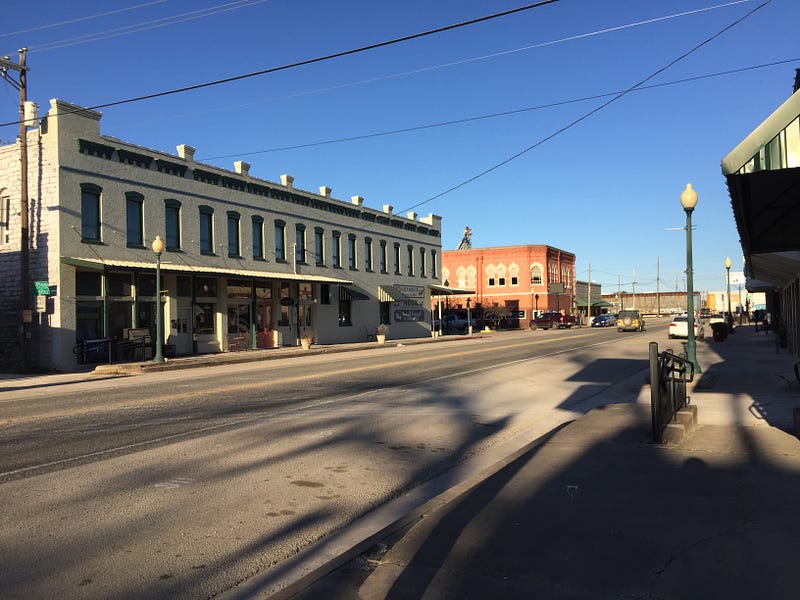
My wife and I made it into town late in the afternoon, probably around three. It was late January and the air was cold, the sun sitting low in the sky, casting a golden glow over the buildings. I noticed there weren’t many people.
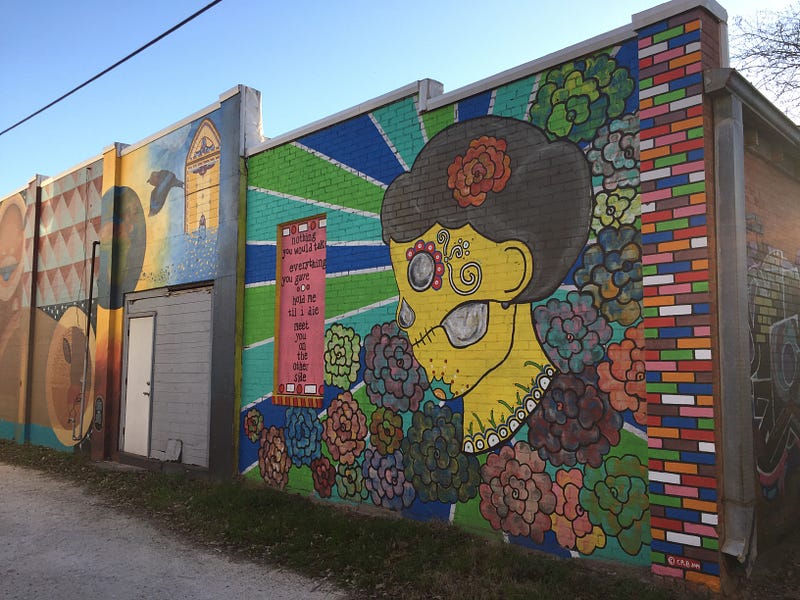
The Cell Block is located down a tiny gravel alley, and parking our large SUV in the minimal parking was a challenge. There are murals on the walls of the buildings in the alley. They looked like they were painted very recently.
One of the first things we noticed inside the Cell Block is that it requires a certain level of intimacy with whomever you’re sharing it. The jail is essentially three areas — a bedroom, a bathroom, and a sitting area. They are all separated by the typical steel bars you’d find in an early 20th century jail. There is at least a fogged glass pane separating the the bedroom and bathroom cells. But you can hear all the sounds that are made in the bathroom, and that can be a little uncomfortable.
Luckily, there is a record player with a radio you can use to mask the sounds of your partner making toilet noises.
We locked up and went to explore the downtown area surrounding the Cell Block. It was a little deserted.
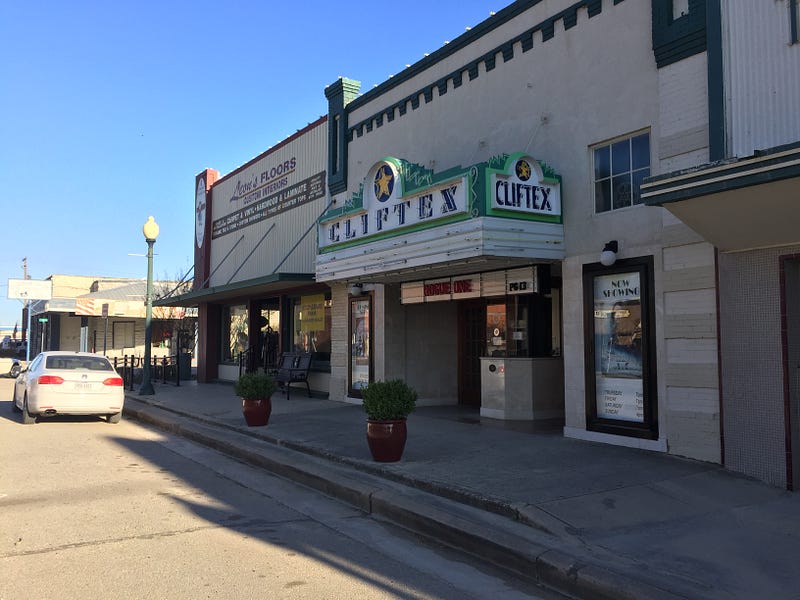
There were two antique stores, along with a couple of art galleries, both of which were closed. We shopped for antiques for a little while, then tried to find a restaurant. There were none open downtown. We asked some locals if there was anything to do, and they recommended the Cliftex movie theater. It’s a theater that’s been in operation since the 1920’s, and still shows new movies. We didn’t go, because they were showing Rogue One, and we’d already seen it. But it still looked pretty cool.
We were expecting a little more life from Clifton, but we weren’t terribly disappointed. I’m from a small town, and I know what they’re like. We came to stay at the Cell Block to get away from the city, to get some quiet. It’s what we got. We explored the town together, walking and chatting.
At dark, we went to the Red Caboose Winery, just on the outskirts of town. There we tasted wine and shared an olive plate, chatting with the owner, a former architect named Gary. On the way back into town, we stopped at Dairy Queen and got a Blizzard.
Back at the Cell Block, we lounged in large chairs in the sitting area. I put on Johnny Cash’s “Live at Folsom Prison” and we read. Every couple hours a train would roll through town, just a couple blocks away, and whistle loudly.
The jail is made of brick and it was cold. There is a small heater, and it worked hard, but it stayed chilly inside our room. We drank a flask of complimentary whiskey from Balcones Distllery to warm up a little.
When we finally went to bed, the charming jail cell became a little unnerving. It was pitch black and very quiet. The brick did not buffer any sounds, and we could hear the occasional car passing by. One even came down the alley, gravel crunching loudly. There are still bars on the windows of the jail, so I wasn’t worried about anyone getting inside. I was a little concerned about the chance of a fire and how we would get out.
I laid in the dark, imagining how it would feel to spend the night in this jail back in the 1920’s. I pretended there was a jailer playing cards just outside my cell, lazily picking his teeth with a toothpick. I’m sure there wouldn’t have been a Tempurpedic mattress to sleep on like I had now, but I bet it would have felt very similar. Dark and lonely. I drifted off to sleep.
In the morning we drank coffee and listened to Johnny Cash’s “Live from San Quentin.” Yes, the music offerings at the Cell Block are a little heavy handed on the jail theme, but it works. There was also a “Jailhouse Rock” record that we didn’t listen to.
The Cell Block is a chance to stay somewhere interesting, to fall asleep in a different world. It feels like traveling through time with just a touch of luxury. I’ll never forget my night in jail.